

This month, we would like to highlight an association with which we have had a long-standing relationship: the Cercle d’Etude de l’Ile de Pâques et de la Polynésie (CEIPP).
We asked its president, Raymond Duranton, for permission to publish one of his articles, which recounts Lapérouse’s visit to the famous Easter Island.
If you are interested in Easter Island, please consider joining this association. You will find the link at the bottom of this article.
Here is Raymond Duranton’s article.
Source
The original edition of the book “Lapérouse, voyage autour du monde” (Lapérouse, voyage around the world), published in April 1791 by Louis Marie Milet-Mureau, is unavailable. Numerous books were based on it, with few changes to the text. The edition published by Éditions Maspéro has been used here. In fact, given the relatively slim subject matter, I have only summarized the parts where Lapérouse talks about Easter Island: chapters IV and V (pp. 64 to 91), a little at the end of chapter III, and a little at the beginning of chapter VI. These thirty or so pages should be read carefully, as the text was written by a sailor on a mission.
Location
Lapérouse’s long journey will not be recounted here. The attached map shows the small section that interests us, with a stopover in Chile. Lapérouse had two frigates at his disposal, the Astrolabe and the Boussole, and on board were the best French scientists of the time.

Ratings
Lapérouse uses units of measurement that vary greatly in size: miles (nautical), leagues, toises, feet, etc. Readers may be misled by the glossary at the end of the book, which gives current measurements. We believe that a league for sailors at that time was worth about 5 km and a toise 1.9 meters.
He uses the term “Indians” when referring to the inhabitants of the islands.
He gives names of islands that have since changed, such as Owhyhee for Hawai’i. Islands that are now known to be non-existent are also mentioned, such as those discovered by ancient navigators.
Approach
During the night of April 8 to 9, 1786, Lapérouse sailed within three leagues of the coast of Easter Island. A footnote (p. 59) indicates that Davis and Cook must have been mistaken in saying that there were two islands at Rapa Nui.
In the morning, the weather being fine, the frigates anchored in the same bay where Cook had stopped, Hanga Roa, sheltered from the winds except those from the west (p. 59).
Reception
In the bay, initially at a distance of one league, the Indians followed the ships, sometimes in canoes, sometimes swimming. Then they came aboard laughing, unarmed. They looked different from those known to Cook and the painter Hodges, who was part of his expedition.
Lapérouse offered the inhabitants gifts of animals (goats, sheep, pigs) and seeds to sow and grow. But the islanders stole items from the crew (hats, handkerchiefs) which they carried on their heads, then dispersed. Lapérouse estimated the islanders’ population at 800, including 150 rather attractive women who stole by offering their favors. But overall, the French felt they had received a welcome without treachery.
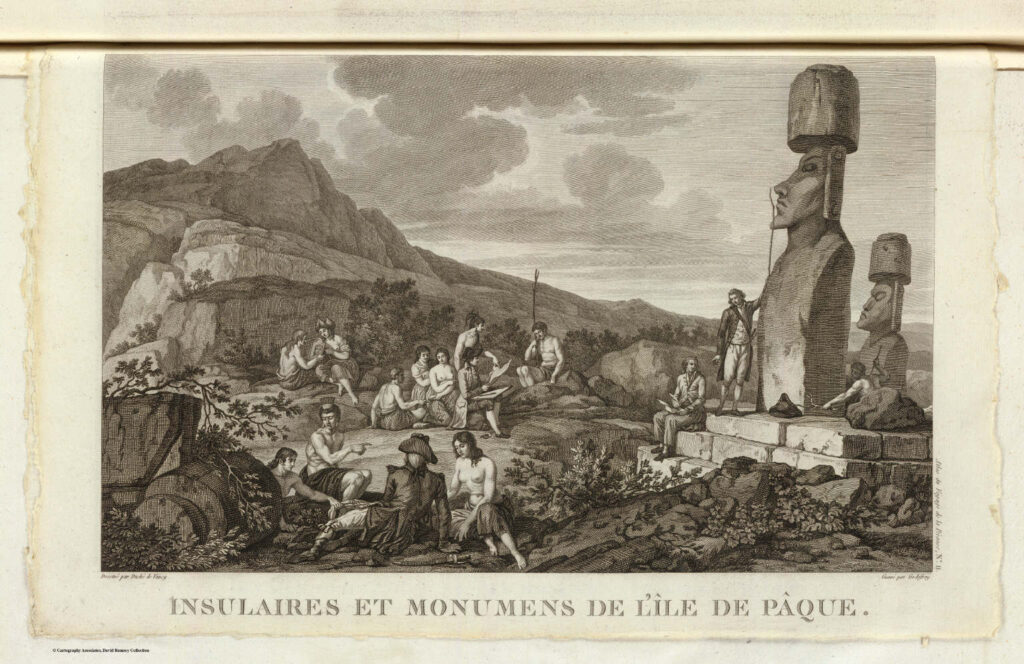
The image above depicts Lapérouse’s crew on Easter Island. At the bottom left, we see people attempting to establish dialogue with the islanders (among them, perhaps Simon Lavo or Lavaux, a Navy surgeon with a gift for languages), artists, others taking notes, and, amusingly, on the right, an islander attempting to grab the hat of a crew member.
At around 8 p.m., Lapérouse “took leave of his new hosts” (p. 60) and signaled to them that he would return the next day. The Indians left in their canoes, dancing as they went.
Preparation
Lapérouse had a tent set up on the island under the command of Morel d’Escures. They were ordered not to use violence, not even rifle butts, to drive the Indians away.
The seventy men chosen to explore the island were divided into two groups. One was led by Lapérouse himself and did not stray far from the frigates. The other (chapter V), consisting of men who enjoyed walking and scientists, was led by Fleuriot de Langle and was to venture deep into the island. All of the observations reported are already well known to CEIPP members, particularly through the book “Les mystères…” and subsequent research. I will only discuss two or three original observations here.
Vegetation
As he was familiar with Île de France, Lapérouse thought he would find similarities with Easter Island. On Easter Island, trees used to exist in groups or sheltered from the wind; otherwise, they would perish. But the inhabitants had been imprudent (p.65) enough to cut them down. That is why only mulberry and mimosa shrubs remained, and not large food-bearing trees as in the rest of Polynesia.
Turned stones kept the night cool and sheltered young plants. But there was no stream; fresh water was very rare. De Langle saw the Rano Kao volcano to the southeast. The inhabitants lived on sweet potatoes and igames (Lapérouse does not mention taro), and little of the surface appeared to be cultivated.

Lapérouse and Cook, sometimes differing attitudes
Unlike Cook, Lapérouse had a favorable opinion of the Indians.
The Astrolabe and the Compass, with a healthy crew, had stocked up on provisions for several months at La Conception and asked nothing of the island’s Indians, even bringing them animals and seeds.
On the contrary, Cook’s ships, after a long and arduous journey from Tahiti, with men suffering from scurvy, were lacking everything, especially fresh water and food. They began to plunder a poor island, much to the misfortune of its inhabitants.
Conclusion
In this passage, which is both old and valuable for its details, we see that Lapérouse has a lot of respect for James Cook but criticizes him on specific points. I feel that this fact has often been overlooked by subsequent researchers, who did not compare the two accounts sufficiently.

Lapérouse was a French gentleman from the pre-revolutionary era when philosophers published their writings. But he was on a mission for the king and had to obey orders. He was careful not to call the Indians “savages” and did not judge them harshly. The Indians did not welcome the newcomers as enemies, but with dancing and singing, which did not prevent them from taking whatever they wanted. Lapérouse thought that this was how they lived, sharing everything. The women stayed behind, looking after the children, while the young and desirable women offered themselves shamelessly when the gift seemed tempting. Their sense of ownership was different from that of the West.
Image representing James Cook
Departure
On the evening of the 10th, around 8 o’clock, all the men and equipment were reloaded onto the ships. Lapérouse said that he left via the north coast (actually northeast at the beginning). On his way to the Sandwich Islands (Hawaii), he saw Easter Island for the last time.
It should be noted that the Lapérouse expedition spent very little time on this island.
Address of the CEIPP association website: https://centredetudesiledepaques.wordpress.com/
Thank you to Anne-Marie and Jean-Michel for their contribution.